Mr Barnett attended hospital because he had severe stomach pains and was vomiting after drinking tea.
The doctor on duty sent him home and recommended he see his GP.
Mr Barnett died 5 hours later at home, from arsenic poisoning.
It was later found out that even if the doctor did act, there was nothing he could do to save Mr Barnett.
Problems:
Could the doctor be charged as negligent regardless despite there being nothing that could be done?
Decision:
The courts decided that the doctor was not negligent because even though he had a duty of care, and had breached that duty, causation could not be proven as on the balance of probabilities, he was going to die anyway.
The claimant (JAH) had gone to A&E because she had lost feeling in her leg, was seen and after no action was taken, left for home.
Within the next few months, her problem persisted and sought medical advice from three different GP’s, all of whom knew her situation well.
In the coming weeks the claimant visited hospital a few more times.
A blood clot formed in her arm as a result of undiagnosed illness and required her left arm to be amputated.
Proceeding her arm amputation her condition deteriorated so quickly in her leg that too was forced to be amputated.
Problems:
Should any/all of the GP’s have spotted the problems that resulted in the claimant’s amputations?
If they are liable, who is more liable and what is the percentage split?
Should the hospitals have done more when she was there?
Decision:
The courts found that only one of the GP’s were negligent and that was because during a visit before the claimants amputations, the GP should have referred her for immediate review.
As this did not happen, the arm was unnecessarily lost.
The leg was found to have been irrecoverable in any case.
The other GP’s were not negligent because at the time that they assessed the claimant, she did not need further medical intervention.
She was awarded £150,000 in damages for her lost arm.
A handy guide to deciphering negligence’s biggest niggles.
This is for those of you who seek a simple explanation to a complex area of law. Use the guide against your own situation to see if you could potentially have a claim.
Let’s start at the very beginning. A very good place to start.
When is a doctor, not a doctor?
When that doctor is on a cruise ship. Apparently.
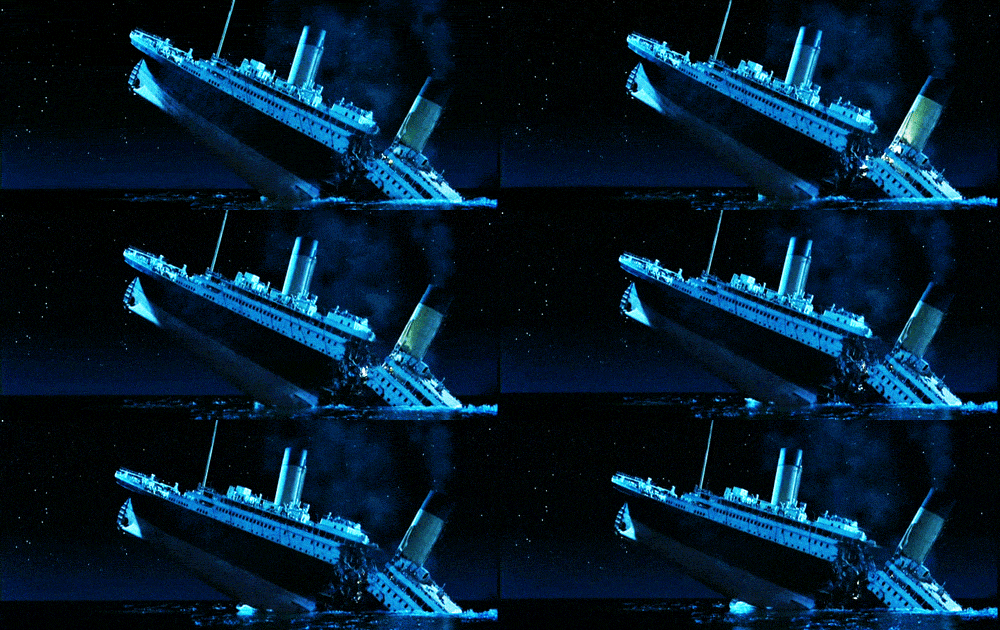
A titanic mess.
No, that wasn’t the worst joke in history.
Rather, a sad reality in the case of Me v X (Cruise Company).
(For legal reasons they shall remain unnamed as the case is ongoing).
In September 2016, I was on board a cruise ship when I developed a pain
in my lower back. After a few days a large lump had formed, so I went to see
the ship’s doctor.
After a consultation lasting no longer that 90 seconds, I was told it was shingles, and there was “nothing to be done as it is likely to get worse before it got better.”
4 days later the lump had blistered, but thankfully I was getting on a plane to come home.
In Dubrovnik departure lounge, the lump erupted.
Upon arriving back in England, I was rushed to hospital to undergo an emergency operation as at this point I was at risk of septicaemia.
To cut a gruesome story short…
I’ve had 7 operations, 2 years off university, and now own a scar that looks Harry Potter’s forehead.
Take my word for it.
Now for the bit you came here for, I will tell you what you need to know for a successful claim in the tort of negligence.
For a claim to succeed you need to prove:
There was a duty of care owed
There was a breach of that duty
That the breach of duty caused you significant damage
Don’t worry, I will go through all this in turn to help specifically identify what needs to be done before instructing solicitors to do the rest of the dirty work.
1. Duty of Care:
A duty of care arises when a doctor enlists you as a patient or as soon as you enter an NHS hospital.
Under the duty of care branch of negligence, there are 3 requirements to establish:
Foreseeability – is it reasonable to think that the doctor’s actions could harm the patient?
Proximity of Relationship – are you the patient that the doctor’s care is owed to? (Sounds obvious but there are cases where people sue a doctor for something they’ve done to someone else).
Fair, Just, and Reasonable – would it be logical to say that this doctor owed you a duty of care?
Darnley v Croydon NHS Trust [2018] is a Supreme Court case that saw an NHS A&E receptionist give Mr Darnley a wrong waiting time of 4-5 hours, so he left as he felt too unwell to wait.
Only to return in an ambulance 90 minutes later in a much severer condition. The courts decided that a receptionist is an extension of the NHS and therefore owed a duty of care to the patient. This is important as duty of care can now extend to non-medical support staff.
Apparently his number was 9,998,383,750,001
2. Breach of Duty:
The best way I can describe breach of duty is by quoting a judge (it’s not as boring as it sounds):
“He is not guilty of negligence if he has acted in accordance with a practice accepted as proper by a body of men skilled in that art.”
To put it another way, would another doctor of a similar skill set have done the same as the accused negligent doctor? If the answer is no, the accused doctor has acted negligently.
Failure to advise a patient on the risks of treatment is another common example of breach.
This was shown in Montgomery v Lanarkshire Health Board [2015] when a gynaecologist failed to advise her diabetic patient on the risks of a vaginal birth as she was likely to have a large baby.
During delivery, complications arose and the baby was starved of oxygen for 12 minutes resulting in being diagnosed with cerebral palsy.
3. Breach caused you Damage:
In law, it is what’s known as proving ‘Causation.’
But-for the Defendants (doctors) actions, the Claimant (you) would not have been injured.
Causation is the most common stumbling block in most negligence claims as you must prove that on the balance of probabilities (51% or higher) that the breach of duty caused harm.
It is for the courts to decide what caused you the most harm. Was there anything that could be done about your original condition or did the doctor fail to give the correct treatment and therefore made it worse?
In JAH v Dr Burne, Devonshire, Jackson & NHS [2018] there were multiple negligent parties and it was up to the judge to decide which of the parties caused the most injury/who was the most negligent. Interestingly, only one out of the three doctors was held liable and the claimant was awarded £150,000 for her injuries.
A case which is fairly close to my own is Williams v Bermuda Hospital Board [2016], as this case involves a delay of treatment that led to a spreading of pus around the body after a ruptured appendix was left untreated for six hours.
Sounds all too familiar for my liking.
This was only a microscopic look at medical negligence and this post was
not designed to be extensive, I wanted to cover the very basics to see if you
have a case and to break down the perplexing legal-lingo.





 The Savvy Law Student